


Content Operations | Monetization Analysis | Publishing Strategy | Performance Analysis | May – June 2026
A consistent publishing schedule is important, but consistency alone does not explain why one month performs better than another.
While managing Airwingmarine’s social content distribution, I compared publishing activity with changes in content monetization to better understand how a consistent posting system related to commercial performance.
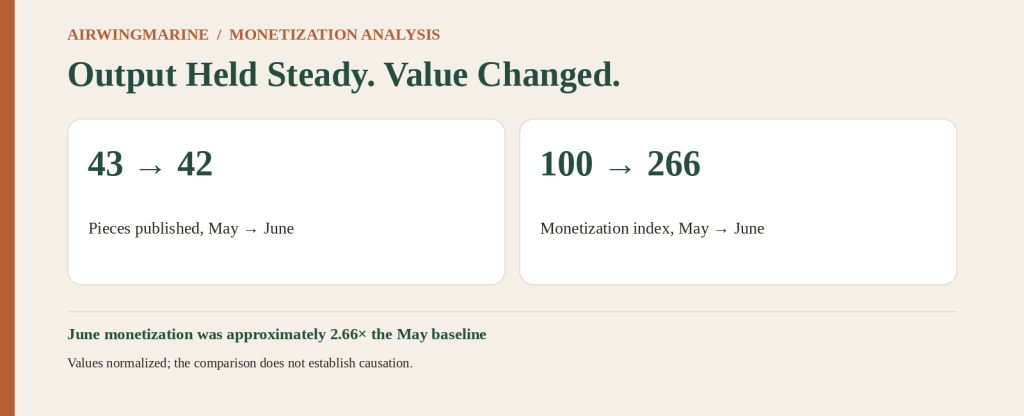
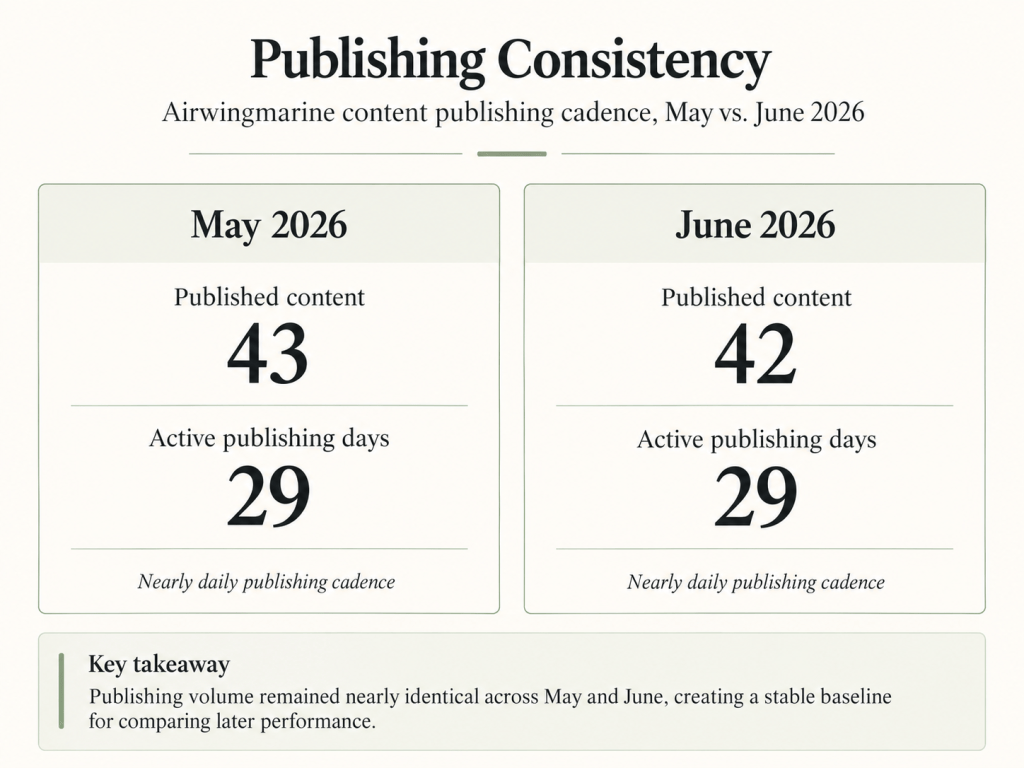
Between May and June 2026, publishing volume remained nearly identical. The account published 43 pieces of content in May and 42 in June.
During that same period, normalized content monetization increased to approximately 2.66× the May baseline.
The comparison reinforced an important distinction: maintaining a consistent publishing cadence creates opportunities for content to perform, but the value generated by those opportunities depends on much more than posting frequency alone.
Monetization results in this case study have been normalized to protect confidential business information.
The Challenge
One of the risks in evaluating organic social media is confusing activity with performance.
A higher number of posts can make an account appear more active, but posting volume by itself does not explain whether the content is producing stronger audience or business outcomes.
Because Airwingmarine already maintained a frequent publishing cadence, I wanted to look beyond the number of posts and compare that consistency with monetization performance.
The question was not:
Did posting more generate more revenue?
It was:
What can we learn when publishing volume stays relatively stable but the commercial outcome changes?
My Role
My work with Airwingmarine focuses on the distribution and management of the brand’s social content rather than the production of the underlying videos.
I manage the publishing system around that content, including:
- Building and maintaining the posting schedule
- Using historical performance and audience behavior to guide publishing times
- Writing social copy for individual posts
- Scheduling and publishing content consistently
- Monitoring audience response after publication
- Moderating negative or disruptive interactions
- Managing the day-to-day activity of the social accounts
- Reviewing performance trends to inform future scheduling and distribution decisions
Because my role centers on distribution, I was particularly interested in understanding how a consistent publishing system aligned with broader monetization performance without attributing every revenue change directly to posting activity.
Establishing a Consistent Baseline
May and June provided a useful comparison because publishing volume was almost unchanged.
The difference was only one piece of content across the entire month.
That made the comparison more useful than looking at two months where one simply contained dramatically more content than the other.
The account was already operating with a consistent distribution system.
The variable that changed substantially was the commercial outcome.
What Happened to Monetization
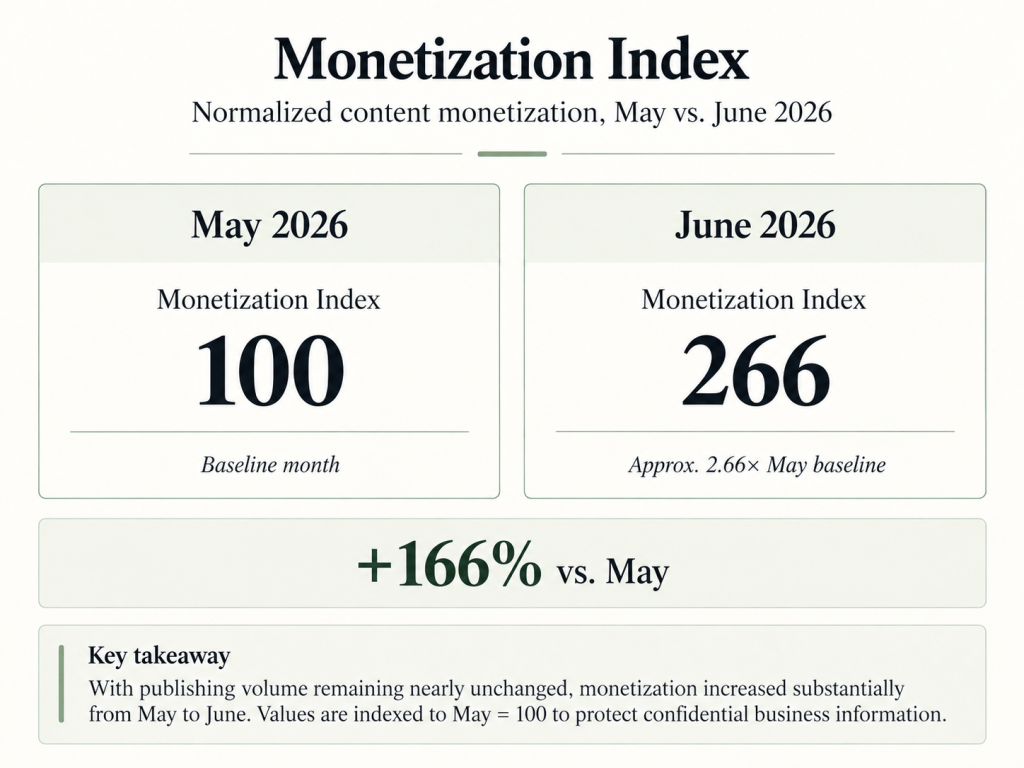
To protect confidential business information, I normalized monetization performance using May 2026 as an index of 100.
June reached an index of approximately:
266
That means monetization was approximately 2.66× the May level, representing an increase of roughly 166%, despite publishing essentially the same amount of content.
May 2026 = 100. Actual monetary values are intentionally withheld.
This was the part of the analysis that mattered most.
If posting volume had increased dramatically alongside monetization, it would have been easy to assume that additional publishing opportunities explained at least part of the increase.
That was not what happened.
Publishing volume remained effectively flat while monetization increased substantially.
Consistency Created Opportunity, Not a Guaranteed Outcome
The comparison does not prove that the publishing system caused the increase in monetization.
Content performance is influenced by many variables, including topic relevance, audience interest, individual video performance, timing, distribution, and the underlying strength of the content itself.
That distinction is important.
My role in managing distribution helps ensure that content is consistently positioned and published at useful times, but a strong content operation should not take credit for outcomes it cannot independently explain.
Instead, the data showed me something more useful:
Consistency created a stable environment in which stronger-performing content could generate greater value.
With publishing volume remaining relatively constant, changes in monetization were less likely to be explained simply by “we posted more.”
That shifted the analysis toward what was performing, rather than just how much was being published.
Why Consistency Still Matters
That does not make posting consistency unimportant.
In fact, I see consistency as the foundation that makes this kind of analysis possible.
A sporadic publishing schedule introduces another major variable. If one month contains only a few posts and another contains dozens, it becomes much harder to separate the effects of content performance from the effects of simply having more opportunities to reach the audience.
By maintaining a steady publishing cadence, I can establish a more useful baseline.
The process becomes:
Publish consistently → monitor performance → identify stronger content patterns → refine distribution → repeat
rather than:
Post more → assume more activity means better performance.
That difference matters when social content is expected to contribute to an actual business.
What I Took From the Analysis
The May-to-June comparison reinforced three things for me.
First, publishing frequency is an input, not a business outcome.
Second, consistency gives content repeated opportunities to perform, but individual content performance determines how valuable those opportunities become.
Third, commercial metrics need to be evaluated alongside content activity rather than separately from it.
A strong month should prompt the question:
Why did the content create more value?
—not simply:
How many times did we post?
Strategic Takeaway
The most valuable result of this analysis was not the increase in monetization itself.
It was understanding what didn’t explain it.
Airwingmarine published almost the same amount of content in May and June, yet normalized monetization increased from an index of 100 to 266.
That showed why I view consistency as infrastructure rather than the end goal.
Consistency creates opportunity. Performance determines the value of that opportunity.
For me, effective social media management means understanding both.

