

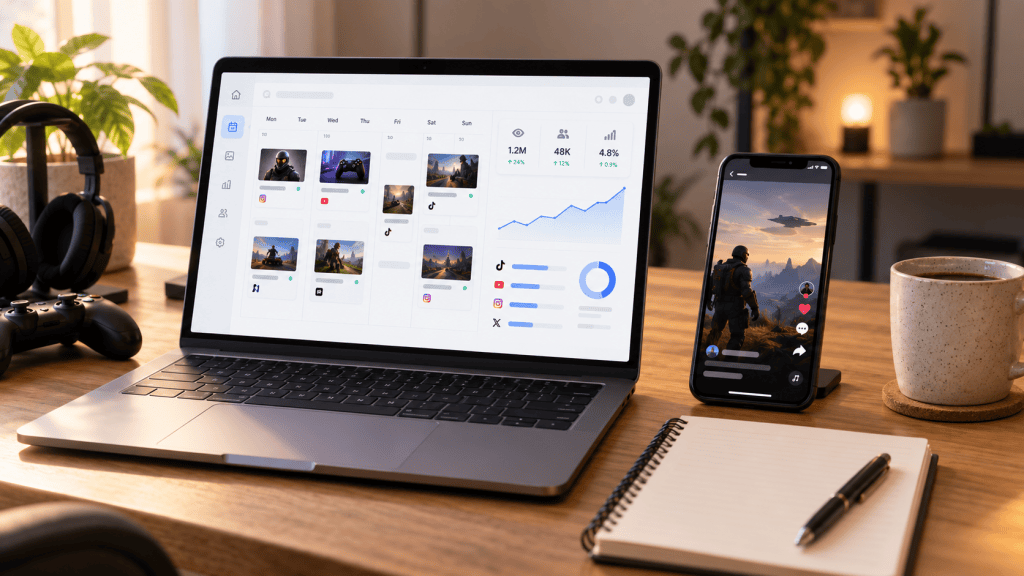
Social Media Management | Content Scheduling | Copywriting | Community Management
Airwingmarine operates in a fast-moving gaming niche where timing, relevance, and consistency matter. New updates, events, guides, and gameplay moments can become highly relevant very quickly, but that also means content needs a reliable system behind it once the video itself is ready to publish.
My role has been to manage that distribution process across the brand’s social accounts.
Rather than treating publishing as simply uploading a video and moving on, I built a posting system around when the audience was most likely to engage, how each piece of content should be positioned, and what happened after it went live.
That included developing the publishing schedule, writing post copy, monitoring audience response, moderating negative interactions, and using performance patterns to continually refine how content was distributed.
The Challenge
Airwingmarine produces a steady stream of gaming content around topics that can move quickly.
Some posts are tied to breaking updates or events. Others are educational, entertaining, or built around memorable gameplay moments. Because of that, posting consistently was important, but consistency by itself was not enough.
The content also needed to go live at times when the audience was most active, with copy that gave viewers a reason to stop and watch.
Once a post was published, the work continued. Audience interactions needed to be monitored, negative or inappropriate responses needed moderation, and performance needed to be reviewed to understand what timing and content patterns were generating the strongest response.
The challenge was to turn an ongoing stream of videos into a more organized and repeatable social publishing system.
My Role
I manage the social distribution and community side of Airwingmarine’s video content.
My responsibilities include:
- Building and maintaining a posting schedule based on audience activity and historical content performance
- Scheduling and publishing video content across social accounts
- Writing copy tailored to the topic and tone of each post
- Monitoring posts after publication for engagement and audience response
- Moderating negative, inappropriate, or disruptive interactions
- Managing the day-to-day activity of the brand’s social accounts
- Reviewing performance patterns to identify stronger posting times and content opportunities
- Adjusting scheduling and messaging based on what the audience responds to
Building the Publishing System
One of the biggest improvements was creating more structure around when content was published.
Instead of treating every available video as something that could be posted at any time, I used previous performance and audience behavior to identify stronger publishing windows and built the schedule around those patterns.
That gave the account a more consistent cadence while still leaving room for timely content when a gaming update, event, or news cycle required a faster response.
The goal was not simply to increase the number of posts.
It was to create a system where content could be published consistently without ignoring the timing and context that influence whether people actually see and engage with it.
Writing for the Content, Not Just Filling the Caption
I also write the social copy that accompanies each video.
Because Airwingmarine covers a mix of guides, updates, gameplay clips, humor, and news, the same caption structure does not make sense for every post.
Some posts benefit from a direct informational hook. Others work better with humor, curiosity, or a reaction that matches the moment in the video.
That means the copy has to support the content rather than compete with it.
The objective is to quickly give someone enough context to understand why the video is worth watching while still keeping the tone consistent with the Airwingmarine audience.
Managing the Audience After Publication
Publishing is only one part of managing the account.
I monitor posts after they go live to understand how people are responding and to keep the comment environment manageable.
That includes engaging with audience activity as well as moderating interactions that become unnecessarily hostile, inappropriate, or disruptive.
For a gaming community, where discussion can become highly opinionated very quickly, moderation has to balance two things:
allowing genuine disagreement and personality while preventing the conversation from becoming damaging to the community itself.
That ongoing monitoring also gives me another source of information about what the audience is interested in, confused about, or reacting strongly to.
What the Content Performance Shows
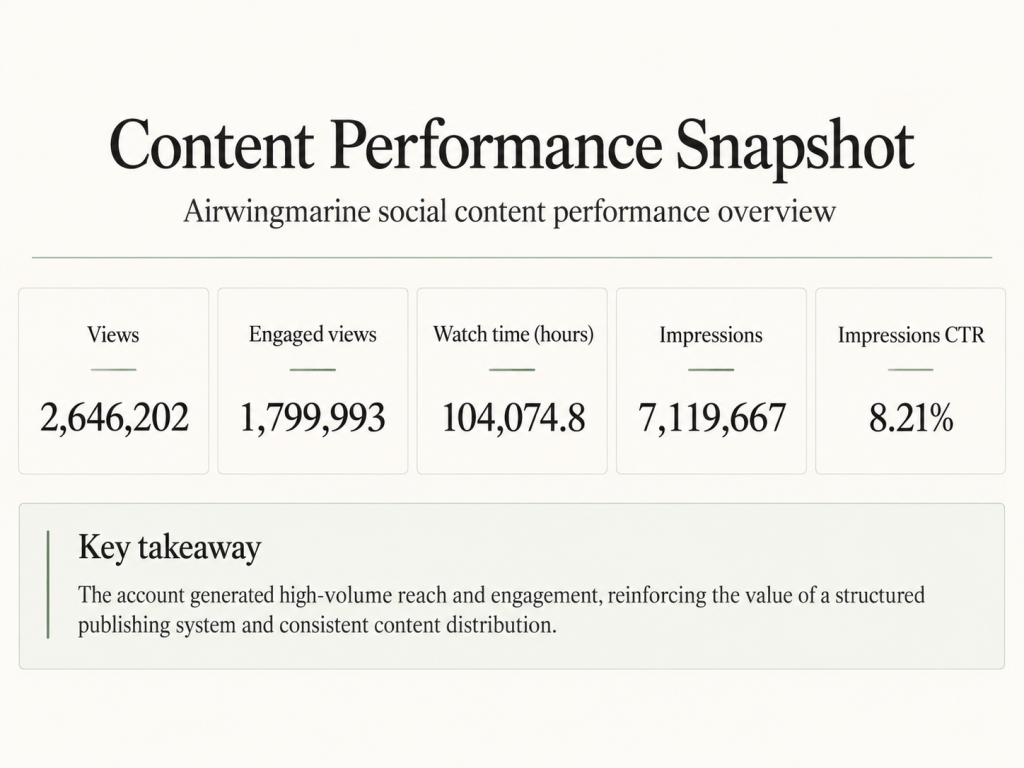
The supplied performance data shows that the account is capable of producing substantial reach across very different types of gaming content.
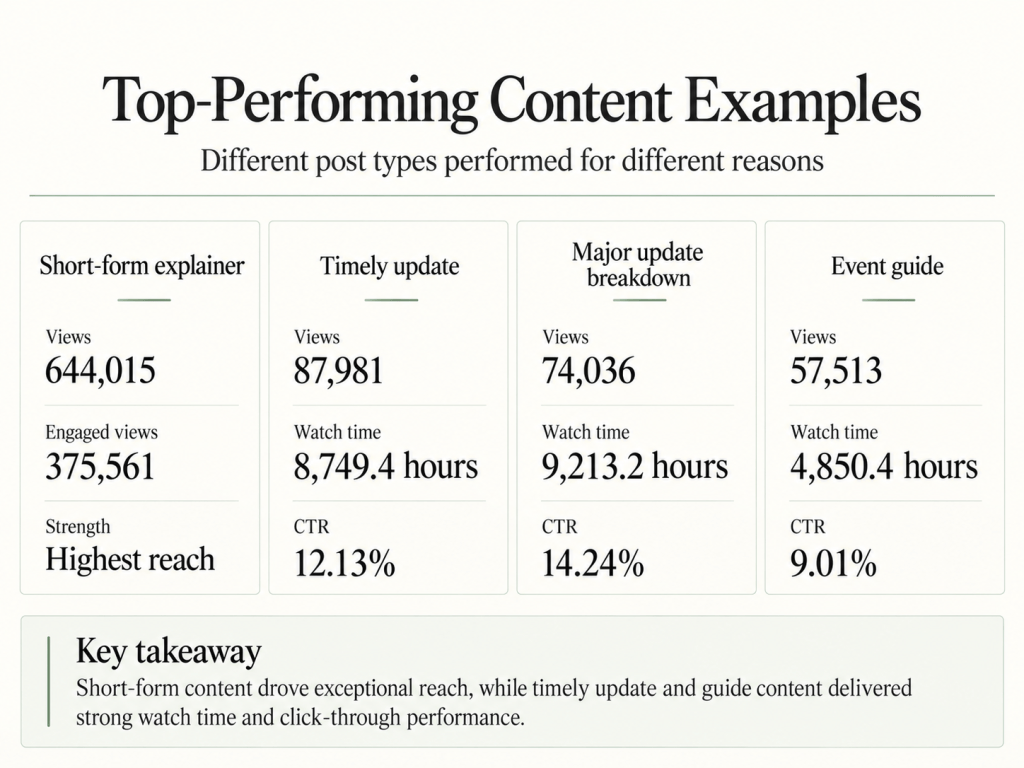
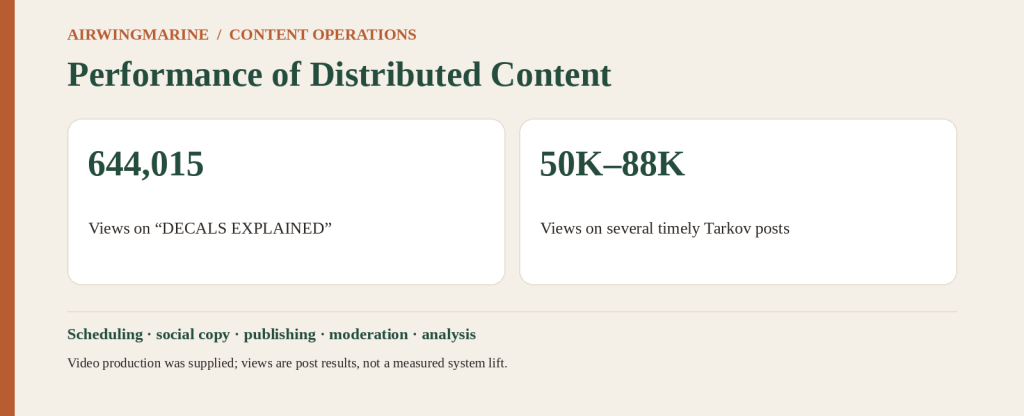
For example, a short-form “DECALS EXPLAINED” post generated 644,015 views, while several timely Tarkov update and explainer posts generated roughly 50,000–88,000 views each.
Other posts demonstrate that performance is not limited to one content style. Gameplay clips, event updates, guides, breaking news, and educational content all appear among the stronger-performing posts in the dataset.
That reinforces why I do not treat the publishing schedule as a fixed formula.
Different topics and formats can earn attention for different reasons, so the system needs enough consistency to keep the account active while remaining flexible enough to respond to what is happening in the gaming community.
What the System Changed
The biggest value of the process is not any single post.
It is having a repeatable system behind the content.
Instead of:
video available → upload whenever possible
the process became closer to:
content ready → evaluate timing → write the positioning → schedule → publish → monitor → learn → adjust
That structure makes it easier to manage a high volume of content while still treating each post as something that can teach me about the audience.
It also makes performance analysis more useful because publishing is no longer happening randomly. Patterns in timing, topic, and audience response can be compared against a more consistent operating process.
Strategic Takeaway
Managing social media effectively is not only about creating content.
There also has to be a system behind how that content reaches people.
For Airwingmarine, my role has been to build and manage that system: deciding when content should go live, positioning it with the right copy, monitoring the audience after publication, and using what happens next to improve future decisions.
The process reinforced something I have seen across different brands:
Consistency creates the opportunity to learn. Performance tells you what to do with what you learn.
That is what turns posting into an actual content strategy.

