


Meta Ads | Paid Social Strategy | Audience Testing | Campaign Optimization | July 2026
Paws & Whiskers was running Meta campaigns across broad, interest-based, retargeting, and product-focused audiences, but the account was not converting efficiently enough for the amount being spent.
Rather than judging performance by traffic alone, I reviewed the campaigns at both the ad set and creative level to understand where budget was going, which audiences were actually producing purchases, and where strong click activity was failing to translate into conversion.
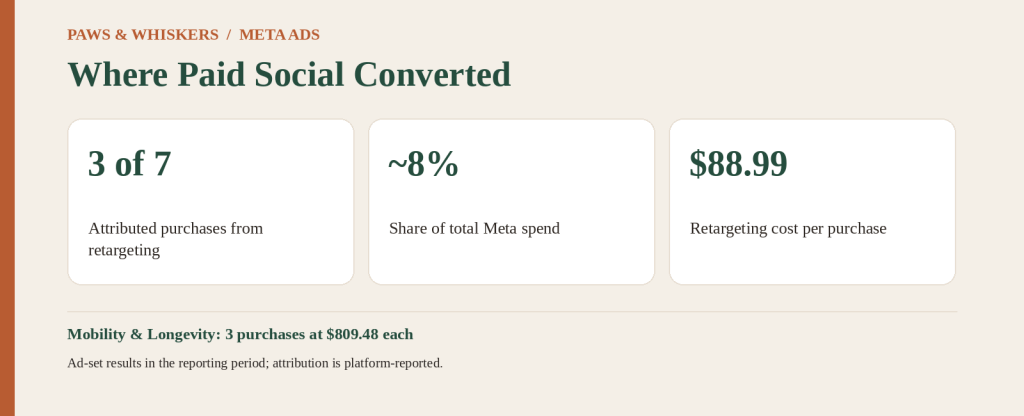
The clearest opportunity came from retargeting. While it represented a relatively small share of total spend, it produced 3 attributed purchases at a substantially lower cost per purchase than the broader prospecting campaigns. That contrast became the basis for evaluating where spend was working, where it was not, and how the campaign structure could be improved.
The Challenge
Paws & Whiskers was generating traffic through Meta advertising, but traffic alone was not translating into efficient customer acquisition. Campaigns were running across broad, interest-based, retargeting, and product-focused audiences, and the performance varied significantly depending on where the budget was being spent.
The challenge was to look beyond impressions and clicks and determine which parts of the account were actually contributing to purchases. That meant comparing audience performance, identifying where acquisition costs were becoming unsustainable, and separating campaigns that were attracting attention from the ones that were moving people closer to conversion.
My Role
My responsibilities included:
- Managing paid campaigns across prospecting and retargeting audiences
- Testing broad, interest-based, and product-focused targeting approaches
- Reviewing spend, impressions, clicks, landing-page activity, and attributed purchases
- Comparing performance across ad sets rather than relying on blended account averages
- Monitoring creative performance to identify differences in engagement and conversion behavior
- Identifying areas where spend was producing traffic without enough purchase activity
- Using campaign data to guide budget, audience, and creative decisions
- Evaluating performance against the larger goal of acquiring customers more efficiently
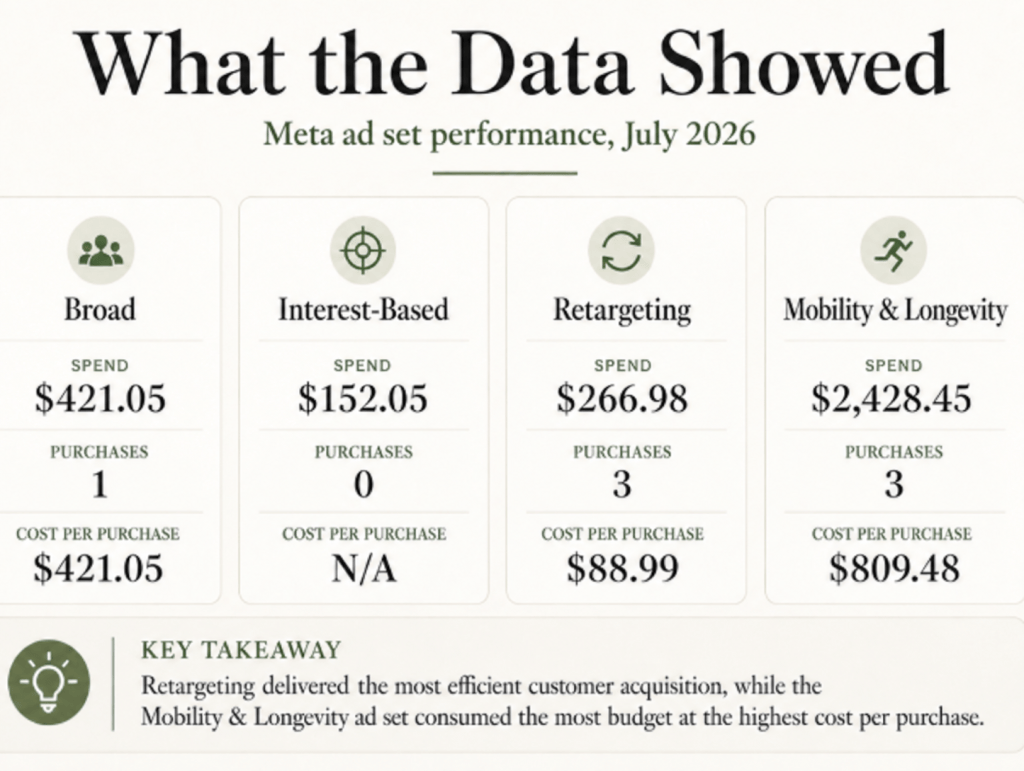
The strongest contrast came from retargeting. It accounted for only about 8% of total Meta spend, yet generated 3 of the 7 attributed purchases during the reporting period. At $88.99 per purchase, it was substantially more efficient than the other audience groups.
By comparison, the Mobility & Longevity ad set spent $2,428.45 and also generated 3 attributed purchases, resulting in a cost per purchase of $809.48. That meant it spent more than nine times as much as retargeting to produce the same number of purchases.
Broad targeting generated one purchase at $421.05, while the interest-based audience spent $152.05 without producing an attributed purchase.
The account was clearly capable of generating traffic, but the purchase data showed that traffic volume alone was not a reliable indicator of efficiency. The more important question became where people were actually converting—and whether the budget being used to reach them made sense.
Creative Examples from the Campaign



Where Efficiency Broke Down
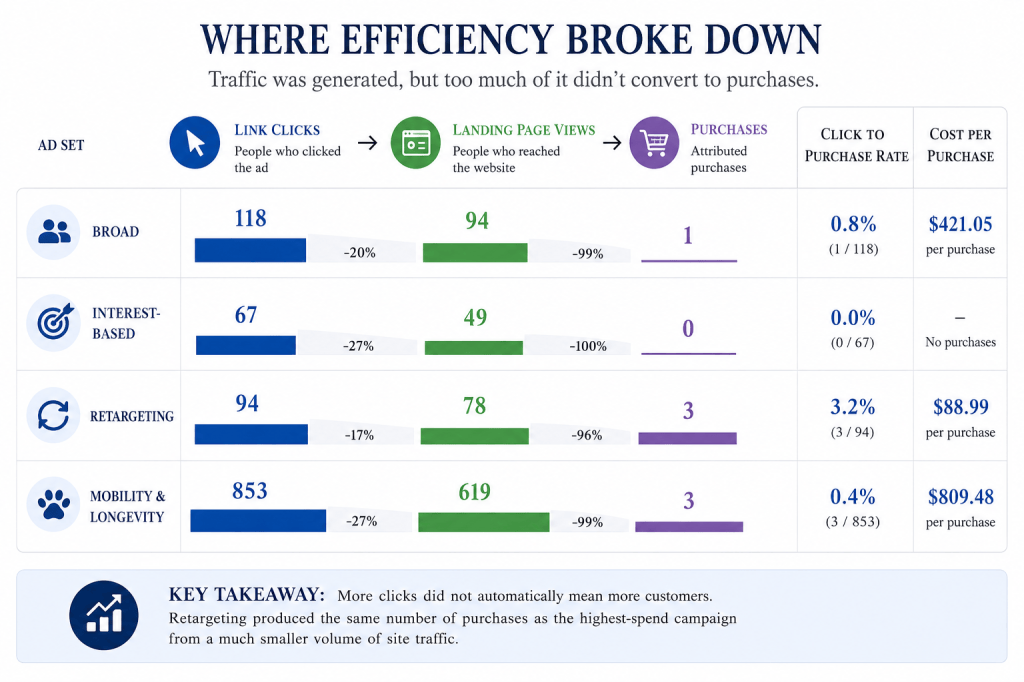
The biggest issue was not a lack of traffic. Several ad sets were generating clicks and landing-page visits, but that activity was not consistently turning into purchases.
The clearest example was the Mobility & Longevity campaign. It generated 853 link clicks and 619 landing-page views, but only 3 attributed purchases. That gap suggested the campaign was succeeding at getting people to the site without converting enough of that traffic into customers.
The same pattern showed up elsewhere at a smaller scale. Broad targeting produced 118 link clicks and 94 landing-page views, but only 1 attributed purchase. Interest-based targeting generated 67 link clicks and 49 landing-page views without producing an attributed purchase.
Retargeting stood apart because it converted a smaller amount of traffic more efficiently. With 94 link clicks, 78 landing-page views, and 3 attributed purchases, it showed that the account could convert when the audience had more existing familiarity or intent.
That shifted the question from “How do we get more clicks?” to “Which traffic is actually worth paying for, and where are we losing people between the ad and the purchase?”
Creative-Level Findings
Looking at performance at the individual ad level showed that results were concentrated in a relatively small number of creatives rather than being evenly distributed across the account.
One of the clearest examples was the Salmon Oil Video 2 retargeting creative, which generated 3 attributed purchases on $241.19 in spend. It also produced 78 link clicks and 63 landing-page views, reinforcing what the ad-set data was already showing: audiences with existing familiarity with the brand were more likely to move beyond the click and complete a purchase.
Other creatives were capable of generating attention without producing the same conversion behavior. For example, several ads generated clicks and landing-page visits but no attributed purchases during the reporting period. That made it important not to evaluate creative performance on CTR or CPC alone.
The creative review also reinforced that an ad could perform well at one stage of the funnel without being the strongest choice for the larger business goal. Click efficiency was useful for identifying what earned attention, but purchase behavior ultimately carried more weight when deciding which creative and audience combinations deserved additional budget.
What the Data Changed
The biggest takeaway from the account was that more traffic was not the same thing as more efficient customer acquisition. The strongest purchase performance came from retargeting, while some of the highest-spend campaigns generated substantially more clicks without producing purchases at the same rate.
Based on that performance, I would prioritize a few clear changes:
- Protect and expand retargeting carefully. Retargeting produced 3 attributed purchases at the lowest cost per purchase in the account, making it the strongest area to preserve while continuing to watch frequency and audience size.
- Reduce spend on inefficient prospecting paths. The Mobility & Longevity campaign consumed the majority of the budget while producing the same number of purchases as retargeting at a much higher acquisition cost.
- Reevaluate interest-based targeting. The interest-based ad set generated traffic but no attributed purchases during the reporting period, giving little reason to continue funding it without a meaningful change to the audience, offer, or creative.
- Judge creative by the business goal, not just the click. Strong CTR or low CPC could still lead to weak purchase performance, so creative decisions needed to account for what happened after the click.
- Use prospecting to feed a stronger retargeting pool. Rather than expecting every cold audience to convert immediately, prospecting could be evaluated partly on its ability to bring qualified visitors into a funnel where retargeting was proving more effective.
The goal was not simply to spend less. It was to put more of the budget behind the combinations of audience, creative, and intent that showed the strongest evidence of moving people toward purchase.
What I Learned
This campaign reinforced the importance of looking beyond surface-level paid media metrics. Clicks, CTR, and landing-page traffic can all help explain how an ad is performing, but they do not tell the full story if the business goal is customer acquisition.
The strongest part of the account was not the campaign generating the most traffic. It was retargeting, which produced the most efficient purchase performance from a much smaller share of the overall budget. That made it clear that audience intent and familiarity were playing a major role in conversion.
It also reinforced why paid media needs ongoing diagnosis rather than passive monitoring. When a campaign is generating activity without enough purchase volume to justify the spend, the answer is not automatically to push more budget into it. The better approach is to identify where the funnel is working, where it is breaking down, and what deserves to be tested or reallocated next.
The biggest takeaway was simple: successful paid media is not about generating the most activity. It is about putting budget behind the traffic, audiences, and creative combinations that have the strongest connection to the actual business goal.

