


Facebook + Instagram | Organic Social Strategy | Content Analysis | January – July 2026
Paws & Whiskers needed a more intentional approach to social content—one that could build visibility without relying entirely on paid distribution. I managed and reviewed performance across Facebook and Instagram, looking at how content formats, posting patterns, and organic versus paid reach were contributing to overall results.
Rather than treating every view as equal, I separated organic performance from ad-supported distribution and looked for patterns in the content itself. As the data developed, Reels became an increasingly important part of the strategy, giving me a clearer direction for what to create, what to test, and where organic growth had the strongest opportunity to improve.
The Challenge
Paws & Whiskers was gaining visibility across Facebook and Instagram, but a large share of that exposure was coming from paid distribution. That made it important to look beyond total views and understand what the brand’s content was actually accomplishing on its own.
My goal was to identify which content formats and topics were earning attention organically, where performance differed between Facebook and Instagram, and how the content strategy could become more effective over time without treating paid reach as a substitute for organic growth.
My Role
I managed the brand’s Facebook and Instagram content strategy, including content planning, creation, publishing, and ongoing performance review.
My responsibilities included:
- Planning and producing social content across Facebook and Instagram
- Reviewing monthly performance and individual content results
- Comparing organic and paid distribution rather than relying on total-view numbers alone
- Evaluating how Reels, static posts, and other formats performed
- Identifying patterns in reach, engagement, and audience response
- Adjusting the content mix based on what the data showed
- Using those findings to guide future content rather than continuing with the same approach by default
The Strategic Shift
The data made it clear that simply maintaining a steady posting schedule was not enough. I needed to pay closer attention to which formats were actually earning attention and which ones were only benefiting from paid distribution.
As I reviewed performance month by month, Reels became a much larger part of the content mix. On Facebook, the shift was especially noticeable: January included 18 photo posts and only 3 Reels, while by March the published content shown in Meta’s format reporting had shifted entirely to Reels.
From there, I leaned further into short-form video while continuing to compare organic performance against paid-supported results. The goal was not to abandon static content completely, but to give more weight to the format that was proving more effective at getting information in front of people quickly and consistently.
That approach also changed how I evaluated individual pieces of content. Instead of looking only at total views, I paid closer attention to organic reach, engagement, content format, and how each post fit into the larger strategy. This helped me make content decisions based on actual audience behavior rather than continuing with the same mix by default.
I chose this Reel not because it had the highest reach, but because it generated the kind of engagement I wanted from the right audience. With 109 people reached, it earned 9 interactions, including 2 shares and 2 saves—signals that the content was useful enough to keep or pass along.
Results
By the end of the seven-month period, organic visibility had improved substantially across both platforms.
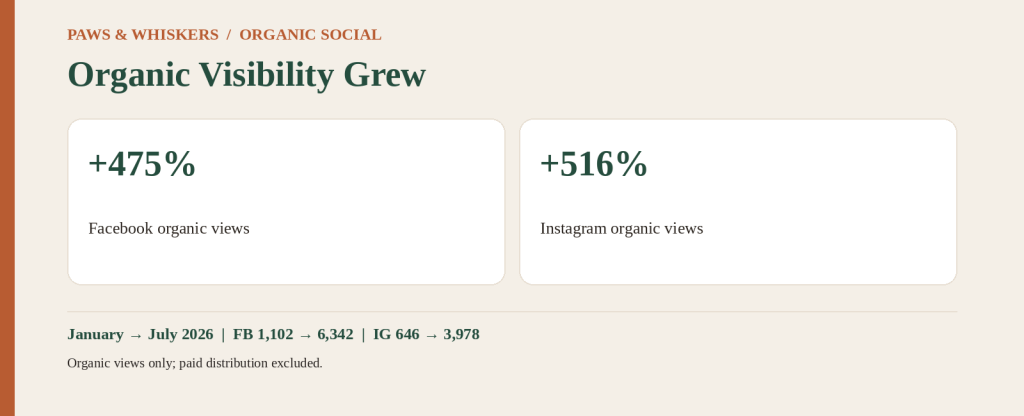
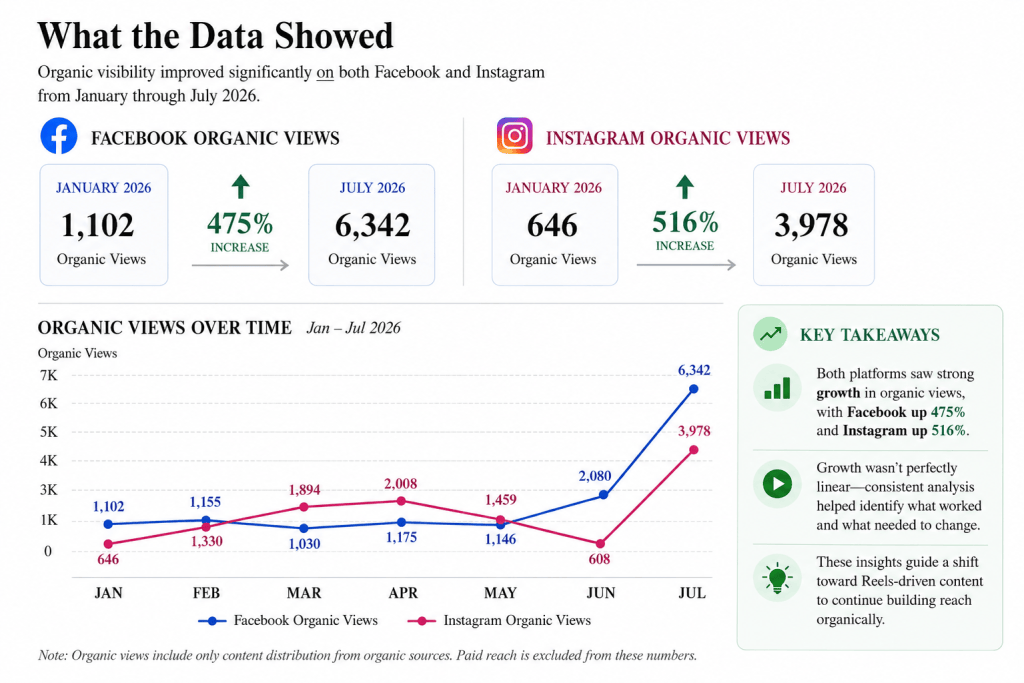
- Facebook organic views increased from 1,102 in January to 6,342 in July — up approximately 475%.
- Instagram organic views increased from 646 in January to 3,978 in July — up approximately 516%.
- Reels became a much larger part of the content mix, particularly on Facebook, where short-form video increasingly replaced a heavier reliance on static posts.
- The strongest content was not always the content with the highest reach. Shares, saves, and other meaningful interactions became important signals for identifying which topics were actually resonating with the intended audience.
The growth was not perfectly linear. Some months declined before performance improved again, which made ongoing review especially important. Rather than treating every dip as a failure, I used those changes to evaluate format, topic, distribution, and audience response before deciding what to adjust next.
What I Learned
This project reinforced how important it is to separate visibility from actual content performance. High total views can look impressive, but when paid distribution is involved, those numbers do not automatically tell you whether the organic strategy itself is getting stronger.
Looking at organic performance separately made it easier to see which content was actually earning attention on its own. It also showed me that the strongest piece of content is not always the one with the largest reach. Shares, saves, and other meaningful interactions can be a better indicator that the content reached the right people and gave them something worth keeping or passing along.
The shift toward Reels came from that ongoing analysis rather than from following a format trend for its own sake. Short-form video became a larger part of the strategy because the data supported giving it more weight, while static content still had a place when it made sense for the message.
The biggest takeaway was simple: content strategy should keep changing as the audience gives you more information. I would carry that same approach forward by continuing to review performance by format, topic, platform, and quality of engagement, then using those patterns to decide what deserves more attention and what needs to change.

